Thursday, September 28, 2006

let's throw stuff at maur

i'm late again. i feel terrible. i've been busy with getting ready for school and working as a "chat partner" in tokyo. yeah, i am a busy man. but i will not disappoint the millions waiting for my japanese tutelage. today i've selected a few very common japanese words that have kind of wacky kanji - and one that i just can't figure out.

1. 頑張る がんばる ganbaru. the first of these two kanji means "stubborn" and "firm." the second one means "to stretch out." putting them together gets you something like "stretching out one's stubbornness." the english equivalent, however, is "to try hard." now, in english, this is pretty simple. to give one's best. in japanese, though, it seems a lot more serious. to stretch out your stubbornness sounds like something pretty strenuous, but people are doing it all the time. if someone gets a job, they'll stretch it out. if someone is playing for the yankees, say, hideki matsui, he stretches out that stubbornness every at-bat. substitute in "firmness" for "stubbornness," and you get something that sounds somewhat like a vaguely sexual reference that might be overheard at a gymnasium (see left). let me assure you that that is not what the japanese mean when they use the word. at least i hope not.

2. 有難う ありがとう arigatou. thanks to styx, we all know that this means "thank you very much-o." duh. now, i've tried to convince my girlfriend that the kanji of this word really means something deep down, but she won't have any of it. she just spits in my face and makes me do the dishes. here's my theory. the first character, "ari," is a fundamental word that means "to exist," "to have," "to be," etc. it is. the second character is actually the root of muzukashii, which means "difficult." the last part, the ou section, kind of signifies an appreciation or a desire to express something. if you follow my train of thought, the straight translation would be something like "i wish to express how difficult it was for this thing to exist." translation: if someone cooks you dinner and you say arigatou, what you're really saying is that you "appreciate the difficulty involved in making this meal exist." a wordy way to say "thanks," but i think it conveys a very nice sentiment. so sery, next time you thank a girl for giving you her number, just spit out a little arigatou magic, and you'll be saying what we all know you really mean: "i appreciate the difficulty you experienced in allowing this number to exist in my cell phone." because, jesus christ, we know the pains these girls suffer every time you wrestle those digits away from her. you dog.

3. 流石 さすが sasuga. i like this one, and i use it a lot. it's used to convey something along the lines of "i knew you could do it," "i expected you to do so well," "you're the man," or "just as i thought." for example, if st. john's wins the national football championship, you could say "sasuga st. john's" - we expect them to win, they fulfilled our expectations, and we want to congratulate them: "i knew you could do it, sju." however, it's much more fun to use it as sarcasm. take the case of kamman, a known cheapskate. he goes to a restaurant and orders something really expensive that he doesn't have the money to pay for. he thinks he'll just find $900 sitting underneath the table somewhere. the dish comes en flambe and kamman digs in. he finishes half the meal and declares the plate finished. he looks around nervously, hoping to find a wad of twenties stuffed in the napkin holder - but to no avail. that's when he pulls out three of his hairs, sticks them in the dish, calls the waitress, and demands a new meal and refuses to pay. of course, he succeeds. this is "sasuga kamman." we fully expect him to do such a thing, and we hate that he gets away with it, but we want to let him know just how much everyone expects him to do such a dastardly deed. am i right? of course i am.

the kanji are weird, though. the first one means "to flow" or "current" and the second one is just "stone." a stone in a current. figure that one out. all i can think of is thomas jefferson. i really don't think it means "we fully expect a rock to be flowing in a current and want to express congratulations for that." that would be so stupid.


ok brethren, that should keep your little tommy tummies full for another week. i promise never again to disappoint. i also promise to expose the plight of sery in every post from now on, because it's deliciously satisfying. oh, and i'm sorry that the title of this post had no relation to the post at all. i just fondly remember that night.

Thursday, September 21, 2006

野球オタク

greetings, and apologies for my tardiness. it won't happen again.

the title of the post today reads yakyuu otaku, which means "baseball freak." that's right. it's time to let my true baseball-loving colors shine through today. the twins are a half game out of the division lead and five and a half games in front for the wild card. oh, baby, baby, baby. i can smell the playoffs already. they kind of smell like dirty socks. wait. that's my room. whatever. i'm excited.

so, since baseball's on my brain these days, i thought, "hell, why not enlighten the starving masses to japanese baseball terms?" and when i acted upon this surging flash of brilliance, i was delighted to find a smorgasbord of juicy items that, in my opinion, would be good comedy material for the next time you and your friends/enemies are watching a baseball game together. you will either be complimented for being so worldly or be beaten for being the annoying kid who knows japanese words. good luck.

anyway, here we go. by recalling my days of watching the momentous high school baseball tournament and calling up "baseball" in my dictionary, i came up with some interesting findings (ordered in reverse order of hilarity):

1. ナイター (naitaa), which means a "night game." it's like americans calling a night game a "nighter." they don't have a special name for day games, but if they did, chances are it would sounds kind of stupid.

2. ストレート (sutore-to), fastball. the word is pronounced like english's "straight." i'm just waiting for the "gay" pitch to come out of the closet. sorry, that was lame.

3. 完封 (kanpuu), a shutout. this one's actually kind of cool. the first character means "perfect" or "complete" and the second one is "seal." in other contexts the word is used to mean "complete blockade," but in baseball, it's a shutout. i think it would be sweet if bert blyleven, at the end of a johan santana shutout, exclaimed "...and santana has imposed another complete blockade." very rad.

4. タイムリーヒット (taimuri- hitto), lit. "timely hit;" an rbi. this one just baffles me. instead of using the very pronounceable letters "R," "B," and "I," the japanese decide to get all subjective and deem a run-producing hit a "timely" one. isn't every hit "timely?" maybe it's just me. i think someone should start trying to get "untimely hits."

5. 死球 (shikyuu), a hit batsmen. now it gets ugly. the first character means "death" and the second one means "ball." THE DEATH BALL. that's what a HBP is in japan. now, what they really mean is a "dead ball," but reading the kanji literally is way more fun in this case. THE DEATH BALL.

6. 刺殺 (shisatsu), a putout. it gets uglier. that first character means "pierce" or "stab." the second character means "killing." so, in japanese baseball, a normal putout is actually a death by stabbing. so, when albert pujols pops up to second, he is actually being thrust mercilessly with a sword. a routine grounder to third results not only in an out, but also in a samurai slashfest. much more thrilling than the tamer "he's out" or "he's gone" used in america, japanese baseball's "he's been stabbed to death" or "a sword-brandishing murderer has rendered the batter lifeless" show us just how much the japanese appreciate violence. to the right, kaz matsui commits murder at second base.

7. ガッツポーズ (gattsu po-zu), lit. "guts pose;" hot-dogging, showboating. i guess this one is just wacky in english, too. how the hell did we get "hot-dogging?" whatever. it's just hilarious in japanese. if a guy hits a home run and flings his bat, watching the ball sail into the stands, that's his "guts pose." to the left, you see a young japanese lad diligently working on said "guts pose." to me, a child of 1990s nickelodeon programming, this word brings me back to the glory days of "guts," the show that pitted little kids competing in faux-sports against each other and culminating in a race up the aggro-crag. it's messed up. just think of barry bonds' "guts pose," and milk will shoot out of your nose. even if you're not drinking milk.

well, i hope you enjoyed those. i enjoyed writing them. here's a tom update:

tom
status: living
location: new apartment outside of tokyo
agenda: start school on oct. 2
inventory: everything except a washing machine.
hit points: 99 (diabetes prevents full health)
weapons: computer, insulin
condition: pleased as punch

take care, fools.

Wednesday, September 13, 2006

there is a house in new orleans

it's wednesday, and that means i get to drop another little turd of japanese happiness on you. yee-haw!

well, today i thought i would let you know that japan's nickname, the "land of the rising sun," is actually a pretty good reading of the kanji for "japan." here's what it looks like:

日本
にほん
japan

the characters used in "japan" are extraordinarily common words by themselves: 日 (nichi, the sun, day) and 本 (hon, book, origin, main, current). the ni from nihon is just another way of reading 日 (it has many). so, if you put them together, you have "sun" and "origin": the origin of the sun, or, the land of the rising sun. pretty cool, huh? if you were a lousy translator, though, you could get "book day" or "main sun" from nihon, but then you'd just be stupid.

now, when you switch those two kanji around, you get a different word, with an entirely different meaning and a different reading, too. it becomes 本日, honjitsu, which means "today." but it makes sense, at least a little, because one of the meanings of hon is "current," so together the kanji couple births "current day" - "today." there will be a test, so please write that down.

i was watching tv the other day, and on came the japanese version of "who wants to be a millionaire," simply called クイズ$ミリオネア (quiz $ millionaire). the top prize is 1 million yen, which amounts to a paltry $86,000. suckers. there have been 20 winners; the american version has had 11. i advise you to check out the other countries that have variants of the program here. anyhow, one of the last questions was:

what language did the word "japan" come from?
a. dutch
b. french
c. chinese
d. portuguese


the answer is c, chinese. turns out the chinese version of "japan" also means "origin of the sun." BOOOOOOOOOOOOOOOOOOOOOOORING!

Wednesday, September 06, 2006

i'm writing too much about one word.

it's wednesday, people, and as promised, i'll deliver to you an interesting japanese word. it'll get you thinking and maybe offer a bit of insight into japanese culture.

ok, today's lesson involves a little word that looks like this:
家内
かない
kanai

now, i'm going to withhold the definition for a second here. i'll tell you what the kanji (chinese characters) mean first. the first one, 家, is read ie, uchi, ya, ke or ka in various cases. it's meaning, though, never changes. it means "house" or "home." the top of the character, with the little vertical line and the dealie with the horizontal line with the two little thingies hanging off the sides, um, ok, screw it. this: 宀. this signifies "roof." according to my dictionary, the thing under the roof is "pig." i'm not kidding. so, as we all certainly know, when there's a pig under a roof, you know you're home. to the right, you'll see a typical japanese house.

the second kanji means "inside" and is pronounced uchi at times and nai at others. upon consultation of my dictionary, the two elements of uchi/nai, 人 (person) and 冂 (enclosure), seem to make a lot more sense as "inside" than roof and pig do as "house." although in many cases i suppose this uchi could refer to your average mime.


putting these two kanji together, we get "house" and "inside." what could this mean? well, some good guesses would be "interior," "household," "indoors," or "video game-obsessed wimp loser," but, boy, those are so wrong. i can't believe how wrong they are. the real meaning is "my wife." interesting, huh? so when a husband introduces his wife, he says "this is my kanai," or, "this is the one who is inside my house." would americans say something like this? it surely seems sexist to me, an american who has been told that women and men are to aspire to similar goals and that women are not exclusively bound to household work. now, i know that 'home-dweller' is not necessarily what japanese people actually, intentionally mean when they use the word. after all, there are plenty of english words that we use unconscious of their origins. however, japanese is different because of its use of kanji. every japanese person knows that 家 means "house" and 内 means "inside." the meanings are right there in the pictures, and there's no way to misread them.

interested, i looked up the etymology of the english word "wife." apparently "wife" has no house-related connotations. in fact, it simply means "woman," although the ultimate source is unknown.

to me, as a learner of japanese, kanai, among other words, was a bit of a window into japanese culture. when i came to japan, i was alarmed at the invisibility of women. i was alarmed at the incapability of men to do just about anything at home; their apparent violent allergy to cleaning, cooking, or doing dishes. i've always heard that language is an illuminating window to a culture's character. turns out it's true.

Friday, September 01, 2006

the name game

greetings.

first of all, a little cleanup. as a portion of my blog's churning throng of readers knows, i got my own apartment about 25 minutes outside of tokyo. i've moved about half of the stuff in. rent is about $450 a month, which is really good considering the location. mmhmm. here's the address:

Tom Kain
Sekizawa 3-7-27
Urban Terrace Apt. 206
Fujimi Saitama-ken JAPAN 354-0025

if you send me mail, i will be really happy, throw myself a party, and run naked around the neighborhood. there's your incentive. choose wisely.

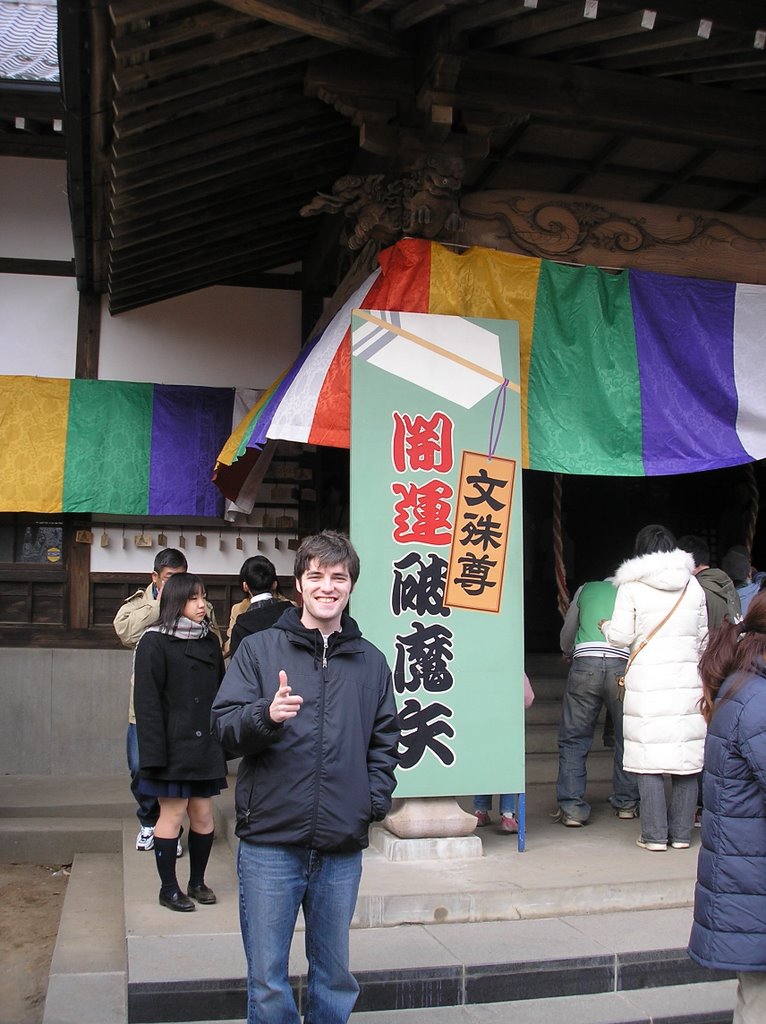
warning: the picture is not of me and my new apartment. although people in coats will certainly come and worship me at my residence, and i will almost always adorn its walls in gay pride colors, the picture above was actually taken at a temple on new year's day, 2006.

speaking of this new apartment, it needs a name. my place in naha was dubbed "xanadu." as wikipedia notes, the name, much like the name "tom kain," is a "metaphor for opulence." what other great apartment names are there? i could fit famous residence names to my own, like changing thomas jefferson's "monticello" to "montiviolin," michael jackson's "neverland" to "alwaysland," or nathaniel hawthorne's "house of seven gables" to "house of seven tables," in which case i'd have way too many tables. yeah, these names suck. i'm open to suggestions. or i could take a page from brian heilman's book and use another language.

on a similarly selfish subject, if you're dying to know what i was doing from the ages of 16 to 20, go here: mmmtomkain.

my next post is fermenting in my head. it's going to be delicious.